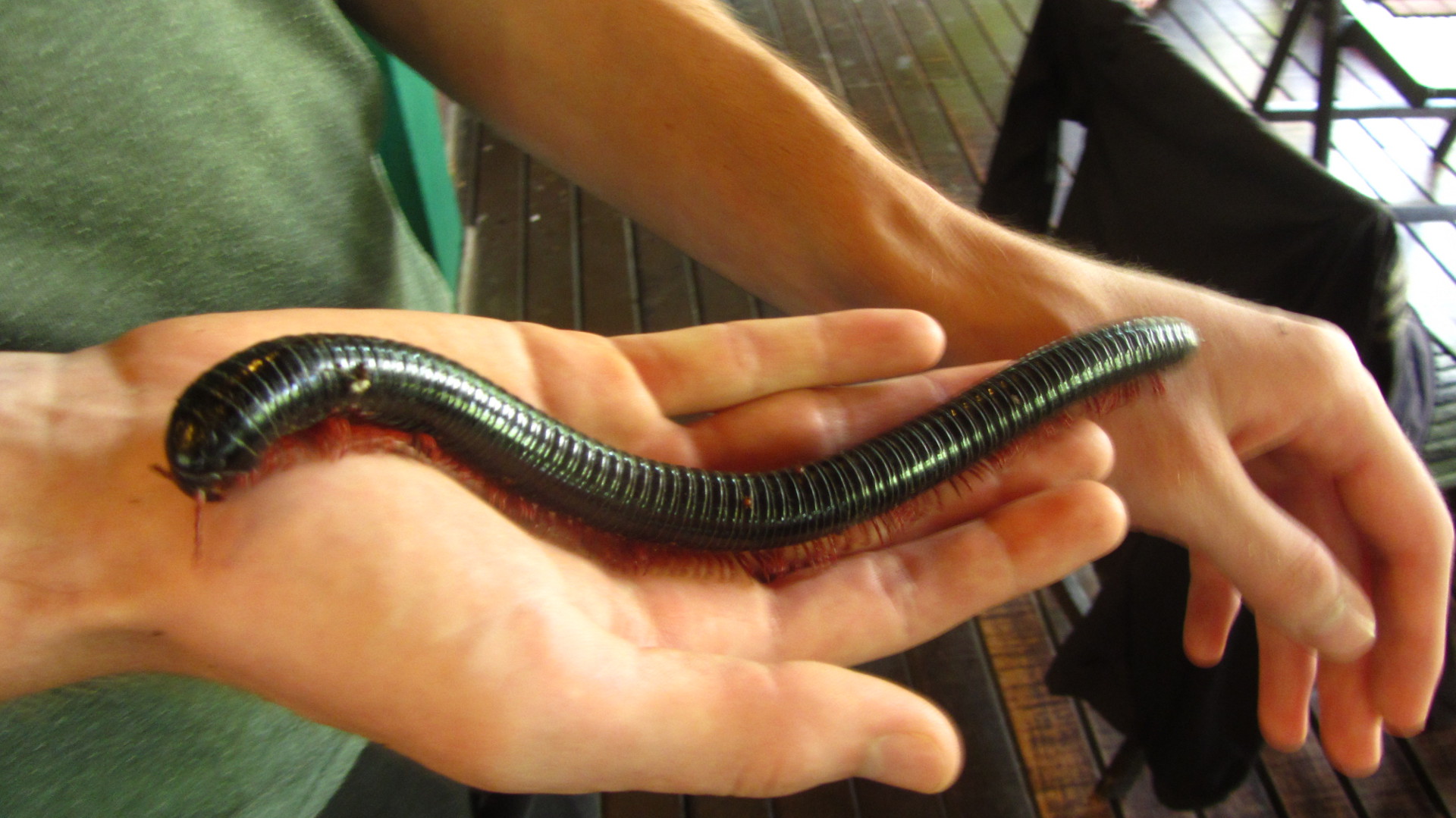
In Borneo, natural surprises await an unsuspecting visitor on every corner. The Borneo giant millipede (Trigoniulus) is a long invertebrate that can reach 20 centimetres in length and may have as many as 300 pairs of legs! Unlike many centipedes, which are nocturnal, carnivorous and often aggressive, this Borneo creature is a harmless, gentle giant of the rainforest – a vegetarian feeding mostly on soft decomposing plant tissue. A physiological difference between centipedes and millipedes is the fact that millipedes have two pairs of legs per segment of their bodies (unlike centipedes which have just one pair). They are mostly black, although apparently some species in Borneo are spectacular in terms of colouration, with bodies made up of alternating red and black or orange and black segments.
I photographed the millipede below at the Tabin Wildlife Reserve in the Malaysian state of Sabah in eastern Borneo. One of the kitchen staff found it in the forest and promptly brought it to the restaurant area to show it to interested guests. The exotic creature moved up his arm slowly, seemingly undisturbed by the fact that it was being handled by a large carnivorous mammal…
(This page has been viewed 2770 times.)